Blog

← Frank Audit

Short pieces on IT audit, GRC and security as it really goes in practice. First posted on LinkedIn, collected here. Some come with a cartoon, all come with an opinion.

Korte stukken over IT-audit, GRC en security zoals het in de praktijk echt gaat. Eerst verschenen op LinkedIn, hier gebundeld. Soms met een cartoon, altijd met een mening. De posts zijn in het Engels geschreven.

Play the Audit

Cartoon from the post: Play the Audit

I like games. Give me a challenge and a good story, and I'll play for hours. So why do I hate security awareness training?

So I built a quiz system. A first step towards sharing stories to quiz on later.

The idea came to me as a leader of youth groups. They like a good story and have zero attention span, so a story followed by a group quiz always gives better results. Sounds familiar to the average organization?

I converted the website, and now it's called Play the Audit. Fully voiced. A few quiz decks, six questions per round, 15 seconds each, multiplayer. Nobody online? No problem, it adds a few NPCs to the room to simulate the feeling.

A disclaimer: the question sets were built in three evenings πŸ˜› The questions aren't wrong, but they don't go deep, and with some of them you could argue for another answer. But that's not the point. The point is to get people talking about security, and to practice it together. Hence the multiplayer. You still need an engaging story. Mine are assessor war stories: what I actually find out there.

Try the quiz: https://www.frankaudit.com/quiz/ And if you want the war stories to go with it, invite me over. Want to quiz your team on your own story? Give me your question set and I'll put it online after a review.

A Needle That Looks Like Hay

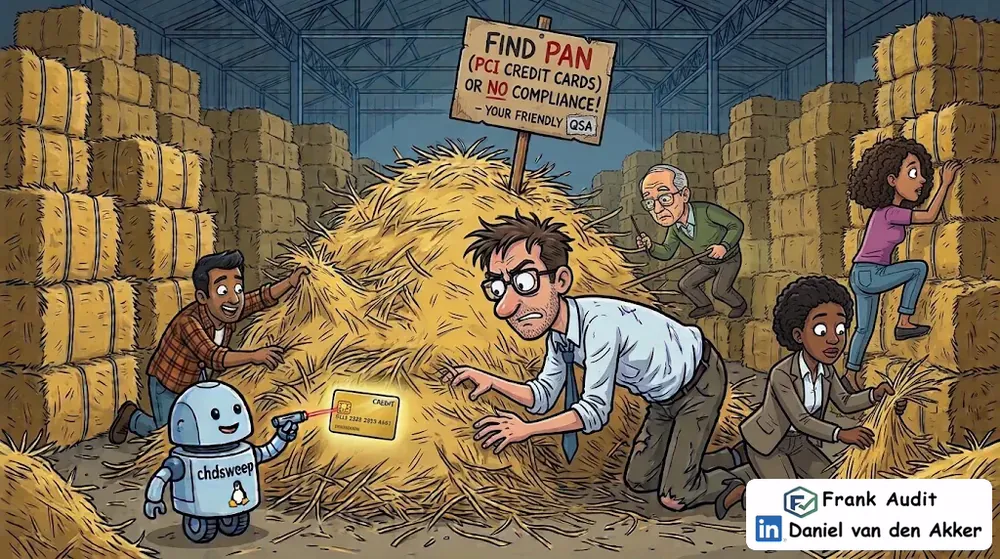
Cartoon from the post: A Needle That Looks Like Hay

Finding a credit card number in a server park is like finding a needle in a haystack, except this needle happens to look just like the hay: usually 16 digits.

Futile, of course. Sensitive data is not supposed to be anywhere but in the secure environment, fenced off with the most expensive security solutions the company can afford. However you still have to prove where PAN is NOT stored anyway.

It is my most disliked discussion with engineers, because even I think it's a fool's errand. Being expected to look for something you are not suppose to find feels like somebody is playing a joke on you. But hey, anything to make your auditor happy.

I cannot make the pain go away, but I can make it more bearable, and share a tool with you that looks for PAN on Linux servers. It is called chdsweep. I made it based on my process knowledge of how to best do this but also make an easy report for all the servers quickly. I will be honest, the AI wrote most of the code, and tests took place in environments of 10 machines. So send me a msg if you want to use it on something bigger; I really want to know if it helps.

So happy hunting for the needle. May you never find it!

https://github.com/LCruel/chdsweep

In Defense of Bob

Cartoon from the post: In Defense of Bob

I do not want to fix Bob. I like Bob.

Everybody seems to know Bob. Control Bob, govern Bob, contain Bob before his brilliant tool becomes a smoldering pile of crashed rockets.

I meet Bob in the workplace. Strong opinions, comment before you finish your sentence, zero tact. But also honest and straight back at you. When his tool works, he is the hero. On his own, the small company boss. In the enterprise, the one to blame, guilty of being the nail that sticks out.

Show me a process and I see the missing owner, the absent logging, the single point of failure. Bob looks at the same process and sees beyond the atmosphere. While I am still counting the GAPS, he launches a rocket!

And when his rocket crashes, we blame Bob. Suddenly he is not on the same team we are all part of. Not the three years we happily ran on his weekend work without asking a single question. We wanted the creativity for free and the sustainability by magic. Then we act surprised when it happens.

So instead of another post about controlling Bob:

  • Give Bob room. Do not judge, engage, and accept that you will not always convince him.
  • Let Bob do the creative part, feed him what would make it safer, and ask your questions during, not after.
  • Bob is no superman, but together you can be a super team.

Bob won't always make it easy. But success is not a one man story, not for Bob, not for you on the control side. It is a team that brings in the win. So what is the harm in guiding Bob to success. Is that not the true job of a risk manager?

Happy Friday!! πŸŽ‰

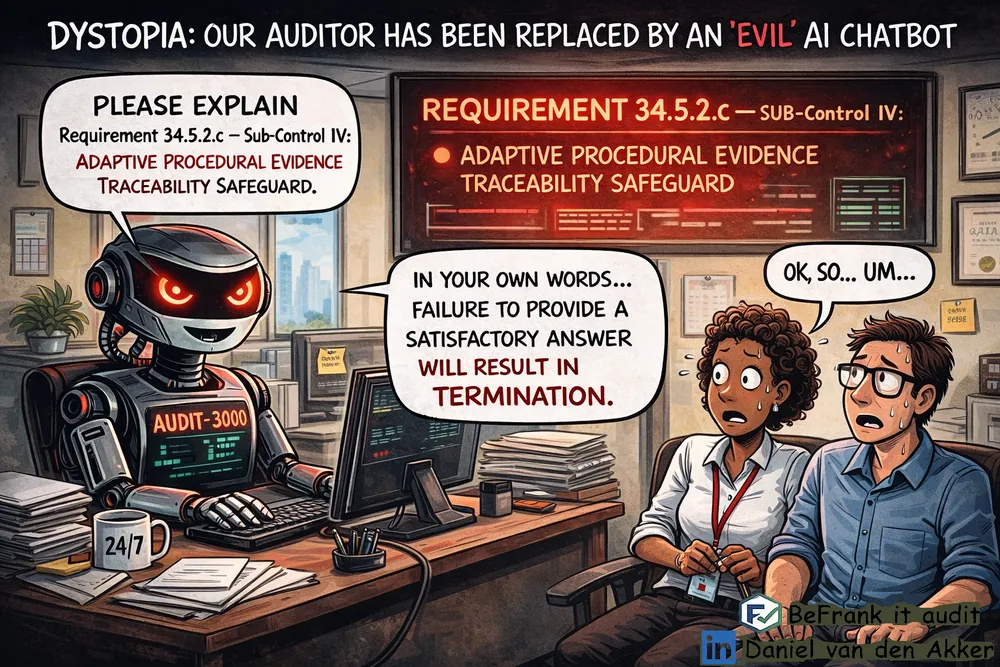
Auditron 3000

Cartoon from the post: Auditron 3000

Thought your human auditor was unfair? Wait till you meet Auditron 3000.

Picture the meeting. You sit down across from Auditron 3000. No small talk, no coffee, no nodding along. It pulls up the tests you already ran "the scans, the config baselines, the log alerts". The ones you buried and swore you'd never speak of again. Auditron 3000 reads them back to you. Line by line. And then the real horror sets in, what if you are really expected to fix them all? Is that fair?

Fair is to stop pretending. Basic security is hard, repetition is boring, and nobody invests in the basics until something broke ... or worse got breached. Auditron 3000 is not to blame for not following the control framework, its simply a fact of life.

Automation and AI will help and change the processes. But even then nothing will come without effort. You need to have a good overview and understanding what is happening, you need to read the manuals and checkup if your team actually did what they promised. That is fair, and you can do that in a nice way.

Connect with me if you want to talk compliance and security β€” maybe I can inspire you, or you me.

Happy Friday!! πŸŽ‰

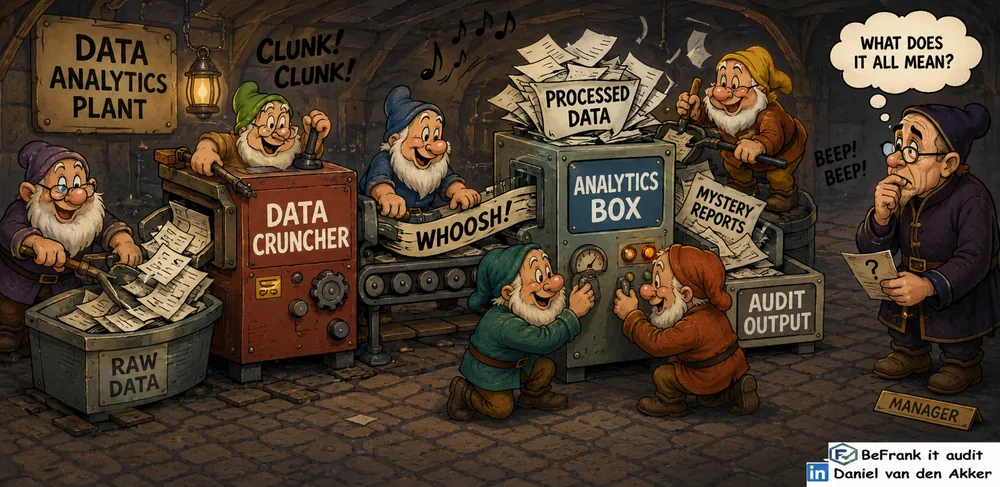
AI Reads. You Decide What Matters.

Cartoon from the post: AI Reads. You Decide What Matters.

Dear audit professionals. AI reads. You decide what matters. Don't switch jobs.

A modest local LLM will chew through tens of thousands of pages while you make coffee. That's the easy part. Reading was never the job.

An auditor's job is to understand the organization β€” not to repeat its rules and policies back to it, but to decide whether those rules are actually keeping quality and risk under control. AI will not tell you which finding matters to business, which control failure are acceptable risks, which pattern in five years of incident logs is the one that costs you the audit.

So stop asking questions just to feed the machine. Follow your audit processes. Listen to the coffee machine chatter. Connect with people β€” hear their successes and their problems. Combine that with what the machine already turned up for the checkboxes. That is what a good auditor does. It has always been about forming an opinion for management β€” based on research ofc.

Not all data will go into the machine, until we can do brain scans.

Happy Friday!! πŸŽ‰

One GRC App to Rule Them All

Cartoon from the post: One GRC App to Rule Them All

A GRC vendor promised me AI that audits you. I asked who audits the Audit AI. Everyone stays quite.

This year "AI" is on every products sales slide deck, including GRC vendors. The routine is recognizable: scare you with the regulatory consequence, sell you the expensive solution, and only later mention you will also need Module X, Module Y, and the Q integration to actually get what was promised. None of it solves the real issue: if risk management and controls are not understood at the board down to operations, you do not have a control environment. You have a dashboard.

You don't need a dashboard to know when things are out of control. What you need is perseverance and knowledge β€” enough to get people to see the dangers, jump over shadows, to actually talk about reality and what is keeping you in control... or not.

There are still good reasons to use a GRC tool. Organizing evidence, activities, and control owners. Framework mapping. Test combinations. AI features genuinely help: summarization, anomaly flagging, first-pass review. A great thing to have, on top of a functioning process. But be careful not to forget: AI will tell you what you wanted to hear on anything, if you ask often enough. So use it and not let it use you.

The business are the only one who really knows β€” its your companies processes, risks, regulations, the knowledge of real state of things. Someone like me can help you turn that knowledge into a risk framework. Once the framework exists, the GRC tool becomes the scaffolding to work on, and safes you time and effort.

How do you turn what you know into a framework? Stick to the basics:

  • What are the top three things that, if they broke tomorrow, would seriously hurt the business?
  • Since they have not happened yet, what are you doing to prevent it from happening?
  • And who is periodically checking whether those preventions still work?

GRC tools will promise you ISO 27001, SOC 2, DORA, NIS2. Auditors hand out certifications when the organization has maturity. Not because you paid for a/their product... well there are moment I doubt this, but they shouldn't.

Old joke, still true: a tool with a fool still makes a fool. Not even the One RΜΆiΜΆnΜΆgΜΆ GRC app to rule them all will change that.

Happy Friday!! πŸŽ‰

Simple Solutions for Simple Problems

Cartoon from the post: Simple Solutions for Simple Problems

Someone should have said no. Should it have been you?

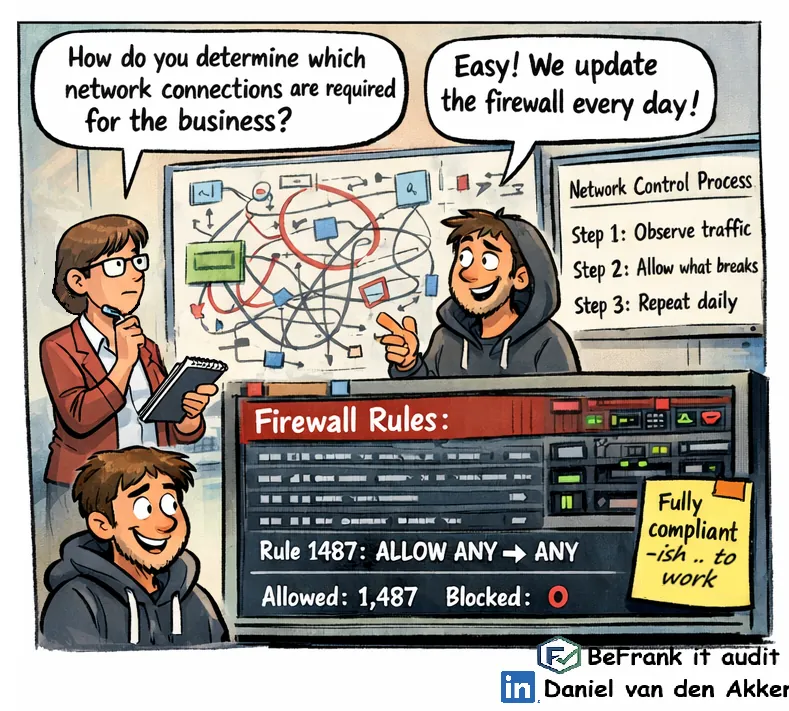
The business asks. Staff nods. Your firewall allows. Your team is too "agile" for security. Every rule finds an exception.

Firewalls are one of the oldest ways to keep external threats out. They also suffer from an even older problem. They do not work if you do not use them right.

Network connections are the simplest thing in IT. Source, destination, port. Allow it and things talk. Block it and they don't. Any technician gets this. So the default should be block. Silence means you never needed it. Screaming means you do. Although some screaming comes with a valid business case, and some just comes with the boss on CC.

Here is where it goes sideways. A network engineer makes connections possible. That is the job. Something does not work, they find a path, open a port, traffic flows, ticket closed. Everyone happy. A firewall manager does the opposite. Gatekeeper. The default answer is no, and you have to justify the yes. Even with the boss on CC. No, unless justified and approved.

Do you actually have a network engineer and a firewall manager, or one person doing both jobs with conflicting objectives. Guess which mindset wins when the business is screaming about a broken connection on a Friday afternoon.

Two years of that and you have 1487 rules, zero blocks, and nobody dares touch any of them. Congratulations, you have a very expensive pass-through device with blinking lights. Nobody is being kept out. Everyone is being waved through.

And if you think this does not apply to you because you are a fancy modern container, cloud, zero-trust, mesh-everything outfit, think again. What are your CSP headers doing. Which HTTP content types do you accept. Which egress endpoints are your pods allowed to reach. Same problem, different name. Still ALLOW ANY to ANY, just wearing a hoodie.

That is not a firewall problem. That is a process problem. Ownership, justification, review, removal. Boring words that decide whether your boundary actually keeps anyone out, or whether ALLOW ANY to ANY quietly becomes your real security posture. They are also the only thing that tells you which screaming deserves a yes, and which one just has an executive signature.

Firewall managers, and whatever you call the role in cloud land, I salute you. Keep saying no.

So what do you actually want easy or secure? Do you respect the no-sayers. Because that job is really hard.

Happy Friday!! πŸŽ‰

Mind Tricks Don't Always Work

Cartoon from the post: Mind Tricks Don't Always Work

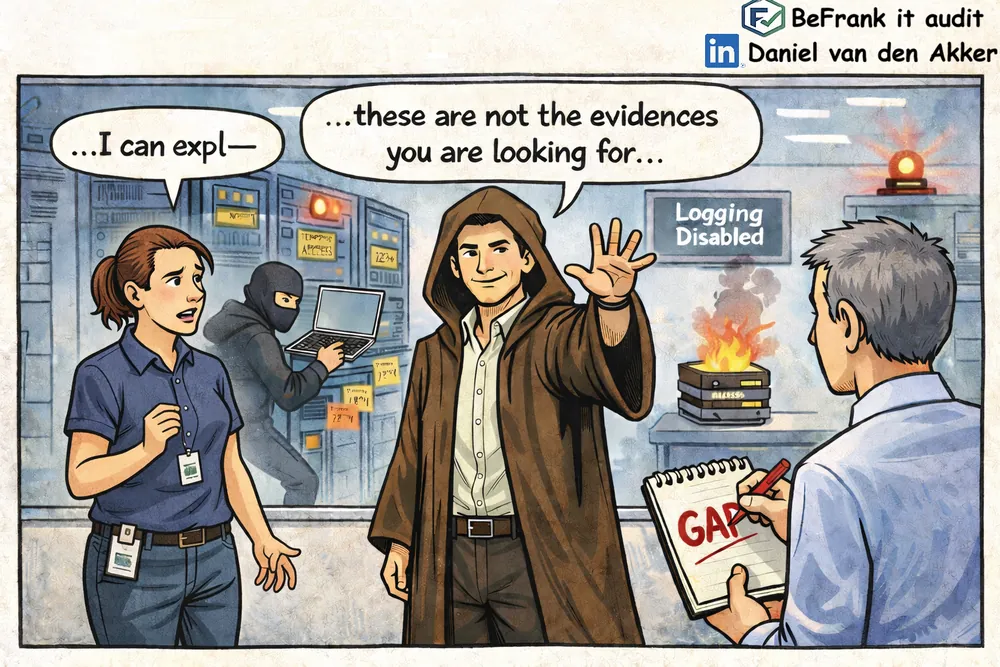
Mind tricks don't always work on auditors.

There is a playbook for fooling your auditor. It is not written down anywhere. It gets passed around in hallways and learned through experience. I have seen all of it.

Let me walk you through it.

The data dump.

Drown the auditor in documentation. Thousands of pages, hundreds of tickets, logs going back three years. The logic is sound: if they are busy reading, they are not looking. The flaw is also sound: auditors write findings on everything they read. Congratulations, you just created your own evidence trail.

The decoy finding.

Pick something you know is wrong. Something visible, low-impact, easy to explain. Hand it over early, let the auditor feel like they found something. Keep the conversation there. This works until your auditor is experienced, stubborn, or both. Also: brief your boss first. Nothing worse than your own escalation path blowing up a carefully orchestrated distraction.

The clean sample.

Your production environment is a mess. Your sample set is not. You spent two weeks making sure those specific machines are pristine before submission. Smart. Just make sure there are no live observations scheduled, and that your technical team understands the unspoken rule: answer what is asked, nothing more. Works right up until someone answers more.

Here is the thing nobody tells you.

All of this takes real effort. The preparation, the coordination, the performance. That energy is not free. You are managing your auditor and your own team at the same time.

If you are good enough to pull off that play, you are good enough to actually fix the underlying problem. And fixing it costs less than the ongoing rehearsals.

Your colleagues are watching too. If you are the one keeping the lid on things, you are also the one responsible when the lid comes off. Help them get to an acceptable level. Not to pass an audit. Because that is your actual job.

The Jedi mind trick works on the weak-minded. Most auditors have seen this movie before.

Happy Friday!! πŸŽ‰

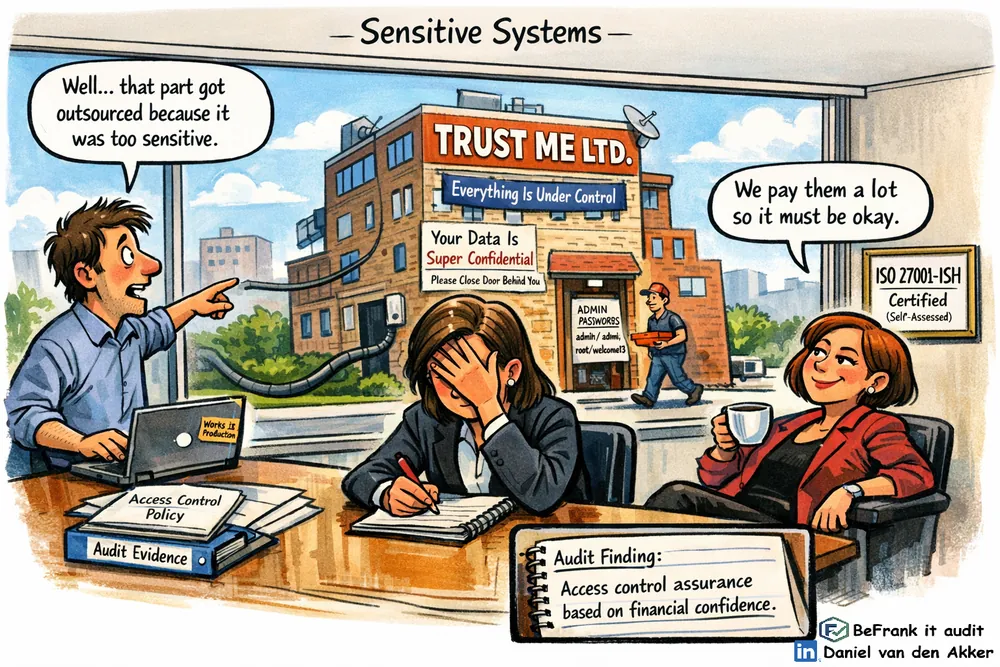
Outsourcing to Trust Me Ltd.

Cartoon from the post: Outsourcing to Trust Me Ltd.

There are good reasons to outsource critical IT infrastructure. Cost efficiency, access to specialist expertise, scalability. All legitimate. I get it.

But I see this so often that the decision is made at the by the wrong people, without the right information and not even involving compliance. The business consequence is predictable. You lose oversight, you lose control, and when something goes wrong you discover the business cannot even articulate what your vendor was supposed to be doing in the first place.

Bad partnership management becomes quickly clear in audit. Nobody knows what is outsourced. Partnership management was reduced to approving invoices. Some had even forgotten that a particular part was outsourced in the first place and simply assumed it worked by magic.

Third party service providers are finally getting the attention they deserve in audits, and supply chain attacks are a big reason why. Some questions I would ask:

  • Did you perform due diligence before selecting this vendor?
  • Does it align with your own compliance requirements?
  • How do you know they are delivering what you asked for?
  • Is there a clear responsibility matrix?
  • Is the service provider at the same maturity level you are?
  • Are there exit clauses, and are they actually workable?

That will determine if you have a structured process for managing this partnership beyond the initial contract. One that tracks not just cost but whether agreed conditions, controls, and service levels are actually being met on an ongoing basis?

Outsourcing does not transfer accountability. Under PCI DSS, NIS2, DORA, you remain responsible for what your third parties do with your data and your systems. What is in your contract matters, but only if you actually verify they are performing their part of the deal. The price tag is irrelevant to the auditor. A competitive rate is fine. Just don't treat it as an indicator of quality.

Audit your partners like you'd audit yourself, because when something goes wrong, the regulator will. That is risk management!

Happy Friday!! πŸŽ‰

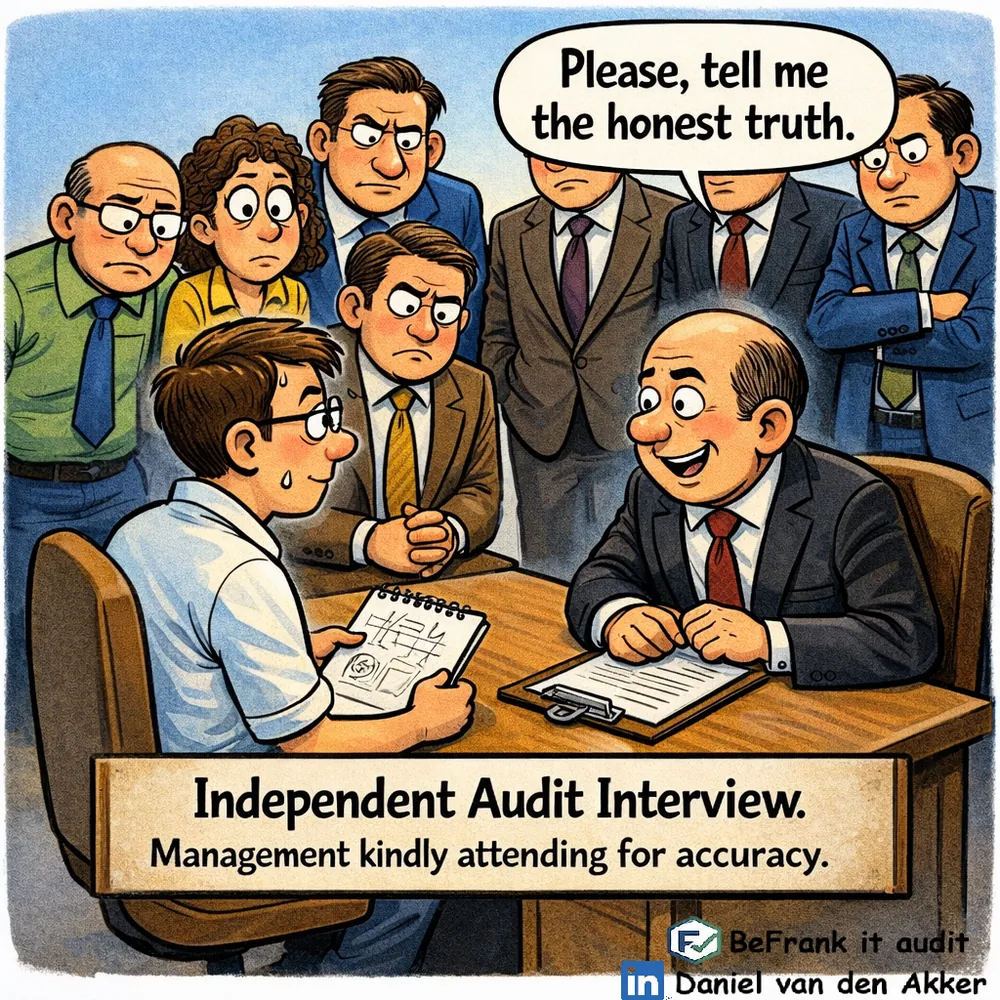
Please, Tell Me the Honest Truth

Cartoon from the post: Please, Tell Me the Honest Truth

The auditor asks the engineer for the honest truth. Management crowds around, staring him down like the whole audit depends on what he says next.

Sound familiar?

Here is the thing: the engineers skills are not the one being tested. The organization is.

A good auditor uses triangulation. Policies and procedures. Data reviewed straight from your systems. And then a conversation with you. Your interview is one leg of that triangle, not the whole thing.

So when management suddenly finds compliance SO IMPORTANT while last week they told you to work agile and lose the "trash": it is management's job to be prepared. Not yours.

If the evidence shows they did not set you up to succeed, use that. Take the gap to your next job review. If a finding lands at your level, it is not your job to hire and train yourself. Use it to get the training you need to succeed. It is in the intrest of the organization!

Best case: the auditor gets technology. Amazing conversation, real insight into how others solve the exact same problems you are dealing with.

Either way, do not be afraid to show the conditions surrounding your work. A good auditor will put the pain where it belongs: People, Process, or Technology. AKA the organization. You are an important part, but not the only one.

And if none of this makes sense in your situation? Consider whether the environment itself is the problem.

Happy Friday!! πŸŽ‰

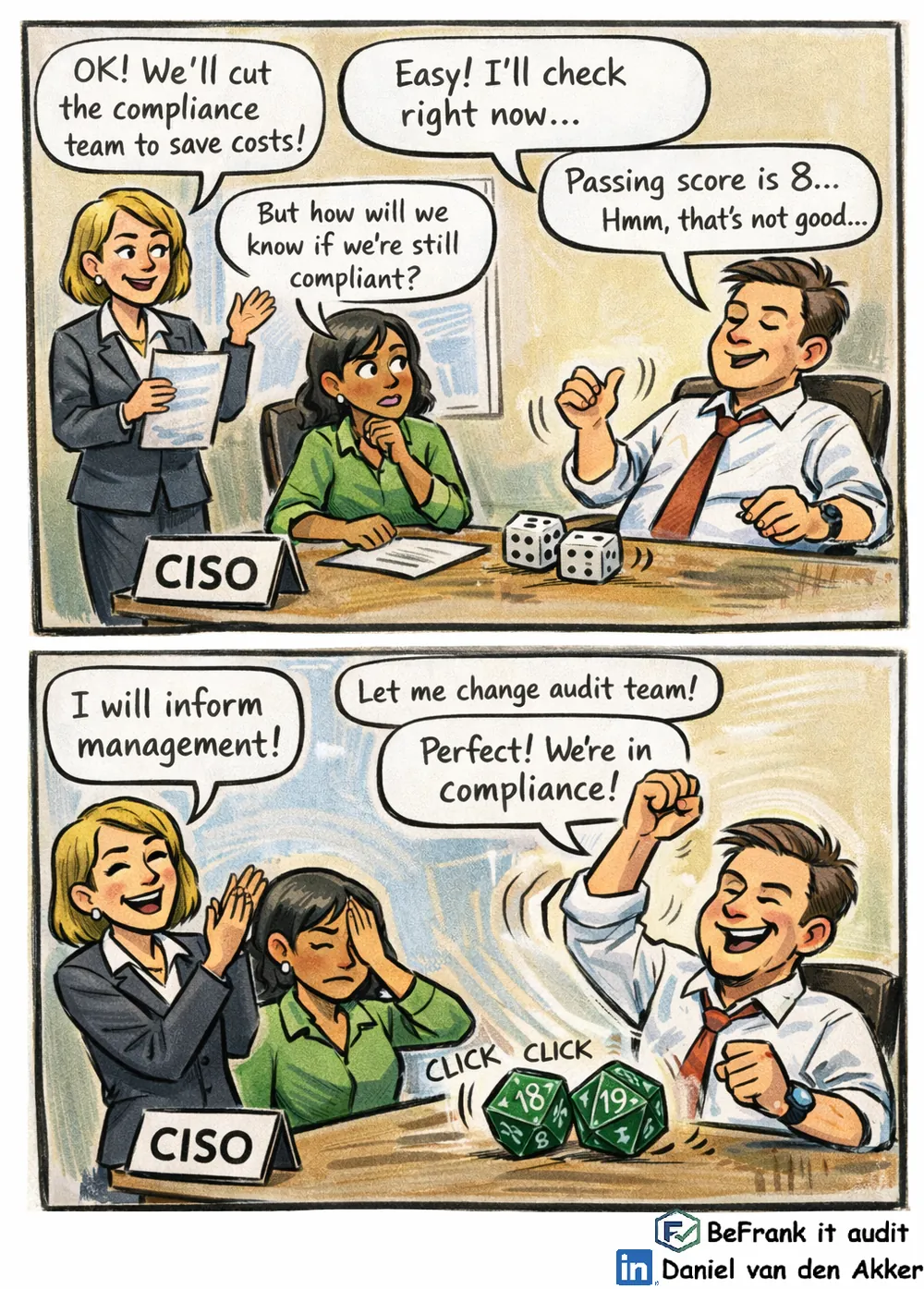
Compliance Will Never Be Efficient

Cartoon from the post: Compliance Will Never Be Efficient

"By definition compliance will never be efficient." Well, maybe there is an efficient version, but for most organizations their ideal picture of efficiency is having to do less to check the box. That is not hard to achieve. Simply stop measuring, do everything right the first time and every time, and if that sounds like too much work, just look the other way.

Like outsourcing to the cheapest provider. Or lowering the quality requirements to absolute zero. Or simply contracting the audit firm with a 100% pass rate. Efficient? Absolutely. Compliant? Sure, on paper.

The irony is that organizations shouting loudest about compliance efficiency are often the ones most creatively invested in not actually being compliant. The checkbox gets ticked. The risk stays. The auditor takes his cash and will not take the risks off your hands either. You tricked him into being apparently compliant, so he is home free. Very efficient.

So have a great Friday. And for all those who genuinely believe in compliance, keep going with a smile on your face. What you do is not unimportant. It is simply, apparently, not efficient. And when you notice your job is just to please, make a choice: stay with it and become the best at that, or go where compliance is actually part of the business value.

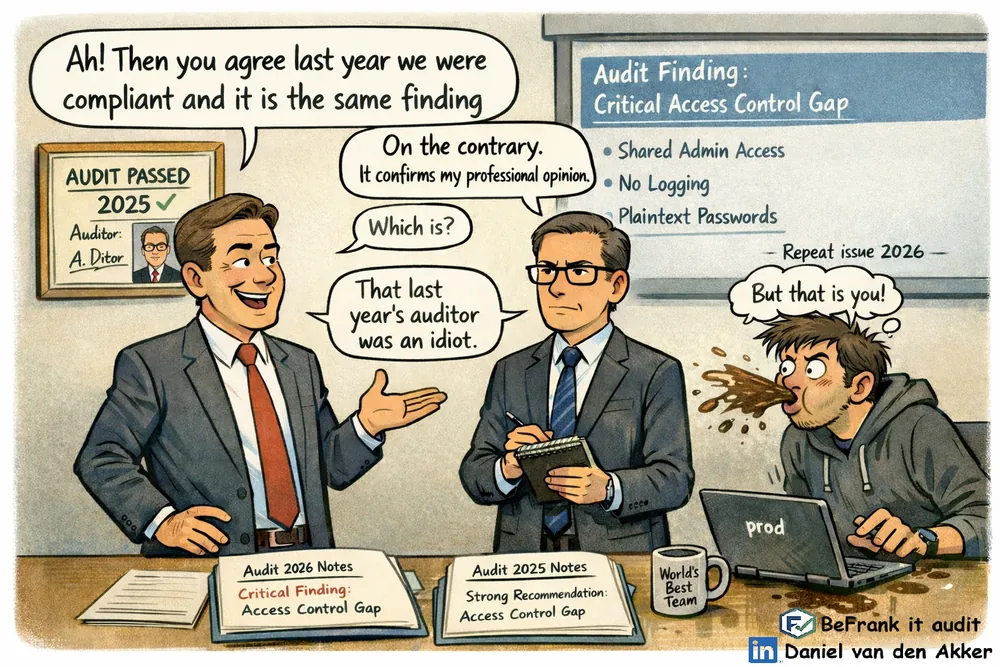
Strong Recommendations

Cartoon from the post: Strong Recommendations

According to LinkedIn best practices, sharing something useful once a week is recommended. As a compliance professional, I strive to adhere to these guidelines. Today, I’d like to share some of my experiences in a Friday fun post, hoping to lift your spirits for the rest of the day.

In my work with clients, I often provide 'strong' recommendations. These are issues that, while clearly not acceptable, might seem justifiable under certain circumstances. I usually reach an agreement with the responsible parties to address these issues before the next audit cycle.

However, when I return the following year, I often find that nothing has changed because no one had the time to resolve them. This leads to a situation where I must inform them of a 'GAP,' prompting a manager to remind me that they need to pass this year and it was fine last year. To which I can only respond: last year's auditor was an idiot.

What follows is usually 'denial, anger, bargaining, depression, and acceptance to fix immediately.'

Happy Friday!